
Walking through the Gallery of 19th and 20th-century European and American Art at Moscow’s Pushkin Museum feels like stepping into a conversation between artistic movements that shaped the modern world. This remarkable collection, housed within one of Russia’s most prestigious cultural institutions, offers an intimate encounter with masterpieces that bridge the gap between classical tradition and revolutionary modernism.

The Pushkin Museum of Fine Arts has been Moscow’s window to Western art since 1912, and this particular gallery is the crown jewel of its collection.
What makes this space so intriguing is not just the famous names on the walls, but also how the artworks communicate with each other across decades and national boundaries. You’ll find yourself moving from the romantic landscapes of the Barbizon School to the bold experiments of the early 20th-century avant-garde, each piece revealing new aspects of artistic dialogue.
The French Impressionist collection here is genuinely breathtaking. Standing before works by Monet, Renoir, and Pissarro, you can almost feel the Parisian light they captured on canvas. The museum’s Cézanne paintings are particularly striking – his Mont Sainte-Victoire series shows how this master bridged Impressionism with the geometric abstraction that would define modern art. These aren’t just pretty pictures; they’re revolutionary documents of how artists began seeing the world differently.

But the real magic happens when you encounter Post-Impressionist treasures. The Van Gogh collection features some of his most emotionally charged works, where every brushstroke pulsates with energy. The Gauguin paintings transport you to his Tahitian period, while Picasso’s early works hint at the cubist revolution brewing just around the corner.

Forget any preconceptions about Russian museums only showcasing Russian art. This collection is truly remarkable.


However, it’s not only the famous artists that make this gallery special. It also features lesser-known artists whose contributions to the art world are equally important. These works offer a glimpse into the broader artistic landscape of the time, showcasing the diversity and creativity of the period.
The American section, though smaller, punches above its weight with carefully selected pieces that represent key moments in American artistic development. These works create fascinating parallels with their European contemporaries, showing how artistic ideas traveled across the Atlantic and transformed in new cultural contexts.

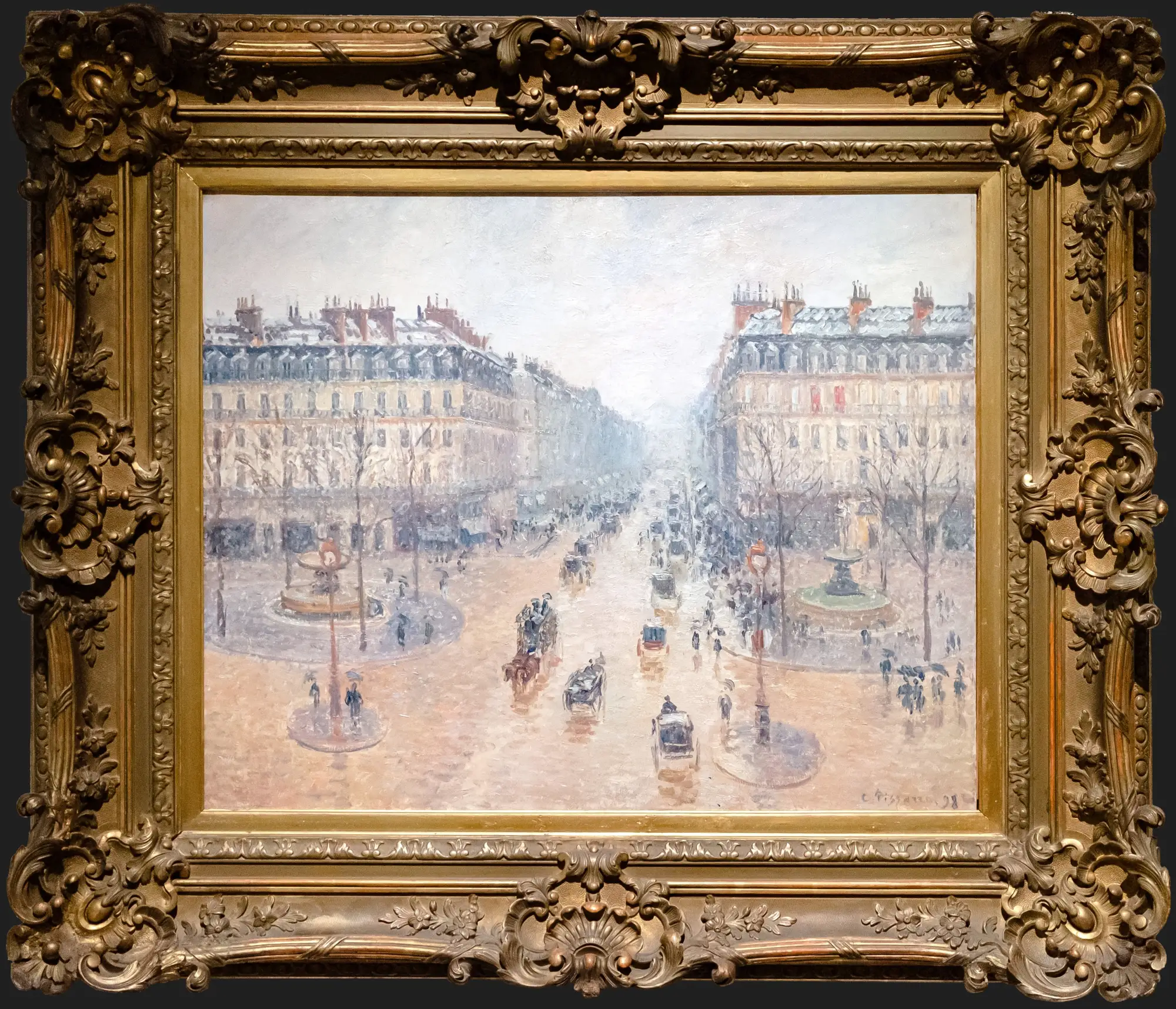

Left: “L’Avenue De L’Opéra, Snow, Morning.” by Camille Pissarro (1898) — Right: “Boulevard Madeleine in Paris” by Frits Thaulow (1894)
"L'Avenue De L'Opéra, Snow, Morning." by Camille Pissarro (1898)
What’s remarkable about experiencing this gallery is how it reveals the interconnectedness of artistic movements. You can see how Impressionism influenced Symbolism, how Post-Impressionism paved the way for Expressionism, and how these European movements eventually intersected with emerging American artistic voices. The curators have created a space where art history unfolds naturally, making complex artistic evolution feel accessible and compelling.

The museum’s architecture is itself a work of art. Its grand halls and elegant design create an atmosphere of reverence and awe. As you wander through the galleries, you cannot help but feel a connection to the artists and the times they lived in.
This isn’t just a museum gallery – it is a reflection of how art transcends borders and continues to speak across centuries, offering fresh insights every time you visit.
⨳


Left: “Ballet Rehearsal” by Edgar Degas (1875-1877) — Right: “Bather” by Henri Manguin (1906)


Left: “Musicians”by Ossip Zadkine — Middle: “Grace” by Alexander Archipenko (1926) — Right: Sitting Woman (Dina) by Cornelis Zitman (1973)

Founded by Ivan Tsvetaev, the gallery gained prominence after the Bolshevik Revolution of 1917 when private collections were nationalized.


Left: “Romans” by Giorgio de Chirico (1926) — Middle: “Woman with a bird on a red background” by Fernand Léger (1952) — Right: “Rebecca by a Well” by Achille Funi (1924)


Left: “Girl with a Cow” by Max Liebermann (1880s) — Right: “Mother and Child” by Mary Cassat (1893)


Gallery of 19th and 20th Century European and American Art, Pushkin Museum of Fine Arts, Moscow, Russia.
The gallery traces the seismic shifts in Western art – from capturing fleeting light to expressing raw emotion.

Top: “Fishing Boats at the Seashore (Trouville, Low Tide)” by Eugène Boudin (1880) — Bottom: “The Beach at Trouville” by Eugène Boudin (1871)


Paul Gauguin works on display at the Gallery of 19th and 20th Century European and American Art, Pushkin Museum of Fine Arts, Moscow, Russia.


Left: “Seated Woman” by Luzanovskaya Lidiya Mikhailovna (1950s) — Right: “Four Maidens Walking” by Carl Milles (1903)


Left: “Hunting Castle. Grunewald in Winter” by Otto Beyer (1930) — Right: “Barges on the Seine” by Maurice de Vlaminck (1905–1906)


Left: “Rouen Cathedral in the Evening” by Claude Monet (1892-1894) — Right: “Rouen Cathedral. Noon (The Portal and the Alban Tower)” by Claude Monet (1893–1894)


The Van Gogh collection features some of his most emotionally charged works, where every brushstroke pulsates with energy.


Left: “The Prison Courtyard” by Vincent van Gogh (1890) — Right: “Portrait of Doctor Rey” by Vincent van Gogh (1890)


Left: “Dance with a Veil” by Emile-Antoine Bourdelle (1909) — Right: “Resting Sculptor” by Emile-Antoine Bourdelle (1905-8)


“Snow in Munich” details, Othon Friesz (1909)
"Snow in Munich" by Othon Friesz (1909)


Left: “Still Life (Seashell on Black Marble)” by Henri Matisse (1940) — Right: “After the Bath, Woman drying herself” by Edgar Degas (1890-1895)


Left: “Pierrot and Harlequin” by Paul Cézanne (circa 1888) — Right: “Rue du Mont-Cenis in Montmartre” by Maurice Utrillo (1914-1919)


Left: “Moreton Castle in Scotland” by James Paterson (1896) — Middle: “Pond at Ville d’Avre” by Jean-Baptiste-Camille Corot (1850-1870) — Right: “Hay Stack (Cart Wagon Crossing the Ford)” by Jean-Baptiste-Camille Corot (1865-1870)


“The Beach at Saint Briac” details, Paul Signac (1890)


The gallery spans twenty-six rooms, with entire rooms devoted to single individual artists or art movements.

Left: “A Corner of the Workshop” by Henri Matisse (1912) — Middle: “The Artist’s Studio (The Pink Studio)” by Henri Matisse (1911) — Right: “Nasturtiums. Panel “Dance” II” by Henri Matisse (1912)
"Mother's Kiss" by Eugene Carrier (1890s)


Left: “Rainy Day” by Cesare Monti (1921) — Middle: “The White House” by Maurice Utrillo (1911-1912) — Right: “Chrysanthemum Bouquet and Japanese Fan” by Pierre-Auguste Renoir (1880)


Left: “Lady in White” by Paul Helleu (late 19th century) — Middle: “Ball at the Paris Grand Opera” by Jean-Louis Forain (1852-1931) — Right: “On the couch (In the white room)” by Edouard Vuillard (1890-1893)
The 19th and 20th centuries French art collection is renowned for its exceptional Impressionist and Post-Impressionist paintings.


Left: “Horse’s Head” by Fernand Léger (1881-1955) — Middle: “Reading (Portrait of Nadia Leger)” by Fernand Léger (1949) — Right: “Composition” by Joan Mirónal (1927)


Left: “Portrait of Victor Hugo” by Auguste Rodin (circa 1883) — Middle: Various ceramic handpainted artifacts — Right: “Eve” by Auguste Rodin (1881)


Left: “Portrait of the Poet Sabartes (Mug of beer)” by Pablo Picasso (1901) — Middle: “Two Girls on the Terrace” by Charles-François-Prosper Guérin (1903) — Right: “Portrait of a Child (My Daughter Klara)” by Rockwell Kent (1914)


Left: Royal Copenhagen Figurine “Clown with Dancing Bears” by Carl J. Bonnesen (1899) — Right: “A Pair of Young Foxes” by Christian Thomsen (1907-1910)


Left: “Vase with Birds” by Andre Derain (late 1900s) — Middle: “Tea Caddy” by Jean Puy (1929) — Right: “Tea Caddy” by Jean Puy (1929)
Stay updated
Receive email updates whenever a new story is published.


