
Moscow boasts an impressive number of museums and art galleries that meticulously preserve masterpieces of history, culture, and art.
It is estimated that there are over 400 private and state-owned museums and art galleries scattered throughout the city.
Russian culture has a rich and long history, deeply rooted in classical music, literature, ballet, and painting. These artistic traditions have flourished and evolved over the centuries, shaping the cultural identity of Russia and leaving an indelible mark on the global stage.
During my childhood, my introduction to Russian art occurred through the Soviet (CCCP) postage stamps that I avidly collected. This was during the time of the Soviet-Afghan war, and being from Pakistan, we found ourselves on the opposing side. Consequently, my exposure to the then-Soviet Union was limited to the unfolding events in Afghanistan. At that time, those postage stamps served as my sole glimpse into Russian art. Decades later, during an extended stay in Moscow, I seized the opportunity to immerse myself in Russian art firsthand. My first destination was the Tretyakov Gallery, where I eagerly sought to explore the finest offerings of Russian artistic heritage.


The State Tretyakov Gallery, located in Moscow, Russia, is one of the foremost museums in the world for Russian fine art.
It was founded by the merchant Pavel Tretyakov in 1856 when he began collecting artworks by Russian artists of his time. Over the years, the collection grew significantly, and in 1892, Tretyakov donated his entire collection of over 2,000 artworks to the city of Moscow, along with funds for a purpose-built gallery to house them.

Russian Art Through the Ages: A Journey at the Tretyakov Gallery
Today, the State Tretyakov Gallery is divided into two main buildings: the original Tretyakov Gallery, which houses Russian art from the 11th to the early 20th century, and the New Tretyakov Gallery, which features Soviet-era art from the 20th century. The collection includes masterpieces by renowned Russian artists such as Ivan Aivazovsky, Ilya Repin, Mikhail Vrubel, and Wassily Kandinsky, among others.


Left: “Abduction of Europe” by Valentin Serov, 1910 ― Right: “Kama river near Yelabuga” by I.I. Shishkin, 1895.
Visitors to the Tretyakov Gallery can explore a diverse range of artworks, including religious icons, landscape paintings, portraits, and avant-garde compositions. The museum offers insights into the rich cultural heritage of Russia and provides a comprehensive overview of its artistic development over the centuries.
With its extensive collection and historical significance, the Tretyakov Gallery is a must-visit destination for art enthusiasts, offering a glimpse into the vibrant and diverse world of Russian art.
⨳


Left: “Profile portrait of I.I. Shuvalov” by F. Shubin, 1771 ― Middle: “Stribog” by Sergey Konenkov, 1910 ― Right: “Gogol” by A. Romazanov, 1854.


Left: “The Coronation of Emperor Nicholas II in the Assumption Cathedral” by Valentin Serov, 1896 ― Right: “Messengers of the Resurrection” by Nikolai Ge, 1867.


Discovering Masterpieces: The Tretyakov Gallery’s Rich Artistic Heritage

⇡ Surikov’s mastery epitomized Russian historical painting in the latter half of the 19th century, focusing on pivotal moments in people’s lives. He famously asserted, “I do not understand the actions of individual historical figures without the people, without the crowd; I have to pull them out onto the street.” His renowned work depicts Peter the Great quelling the 1698 Streltsy uprising in Moscow, personally engaging in the rebels’ execution. Surikov manipulated reality, bringing St. Basil’s Cathedral closer to the Kremlin walls, compressing Red Square to intensify the psychological confrontation between Peter and the red-bearded strelets. However, proximity to the tsar diminishes the rebels’ defiance, aligning with historical inevitability.
― Source: The State Tretyakov Gallery


Left: “Sick Girl” by Vasily Polenov, 1886 ― Right: “Portrait of Philosopher and Poet Vladimir Solovyov” by Nikolai Yaroshenko, 1895.


Left: “The Old Park” by Aleksandr Golovin, 1910s ― Right: “At the Dressing-Table (Self-Portrait)” by Zinaida Serebriakova, 1909.


Left: “A Peasant Girl with Embroidery” by Alexey Venetsianov, 1843 ― Right: “A Girl in Blue Dress (Portrait of Natalia Sergeyevna Zaryanko)” by Sergey Zaryanko, 1870.

From Icons to Avant-Garde: Tracing Russian Art Evolution at the Tretyakov Gallery


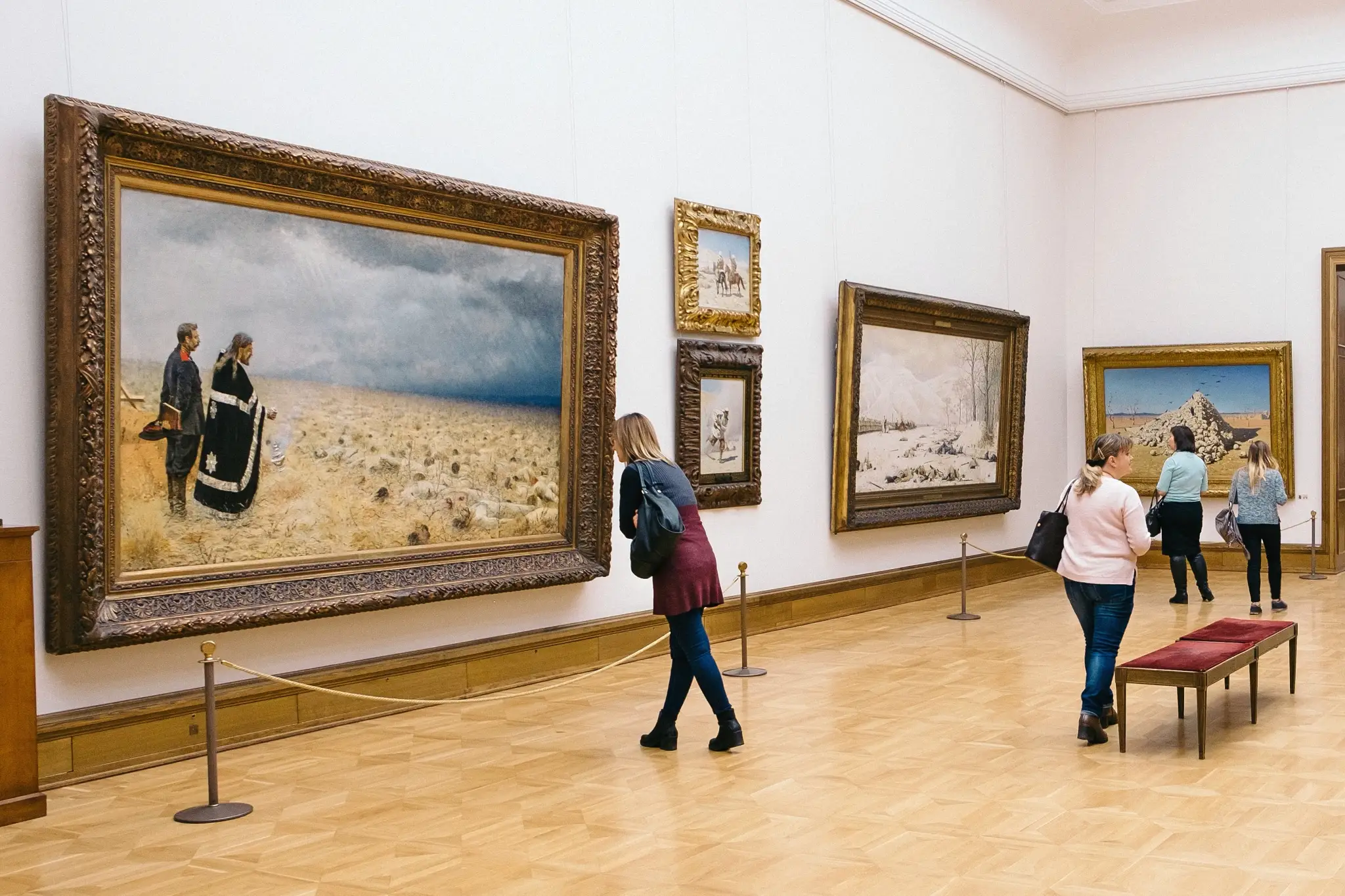
“Display of Trophies” by Vasily Vereshchagin, 1871-72.


⇡ Painted in 1772, Torelli Stefano’s “Allegory of Catherine the Great’s Victory over the Turks and Tatars” intertwines concrete historical figures with the artist’s imaginative flair. Commissioned to celebrate the Russian army’s triumph in the first Russo-Turkish War (1768-1774), Catherine the Great assumes the guise of the goddess Minerva, riding a triumphant chariot. This allegorical portrayal merges historical accuracy with artistic interpretation, highlighting Catherine’s role in the military victory while incorporating symbolic elements to exalt her leadership. Torelli Stefano’s masterful fusion of reality and imagination captures the essence of Catherine’s reign and the significance of the Russo-Turkish conflict within Russian history.
― Source: The State Tretyakov Gallery


Left: “Portrait of the Artist M. Dobuzhinsky” by Konstantin Somov, 1910 ― Right: “Portrait of Mikhail Kuzmin” by Konstantin Somov, 1910.
From Classic to Contemporary: Delving Into Russia’s Artistic Soul


Left: “Portrait of an old woman” by unknown ― Middle Bottom: “Portrait of Composer Modest Musorgsky” by Ilya Repin, 1881 ― Right: “Portrait of a Woman” by Ivan Makarov, 1860.


⇡ Maximov had humble roots himself and deeply understood rural life. He aimed to awaken viewers to love and have a genuine interest in impoverished existence. His works, such as the dimly lit peasant huts, bustling with lively hosts and guests, and the solemn scene of a newlywed couple beneath icons adorned with intricately embroidered towels, offer poignant glimpses into the essence of Russian peasant life. When reflecting on his immersion in country life, Maximov candidly expressed to P.M. Tretyakov that he continuously compared his art with the unadorned authenticity of rural existence, devoid of artifice or pretense.
― Source: The State Tretyakov Gallery


The Masterpieces of Russian Artistry and Culture

⇡ The painting portrays a dense conifer forest, a recurring theme in Shishkin’s works, conveying the grandeur and timelessness of nature. Shishkin’s unique compositional technique, cropping treetops at the canvas edge, immerses viewers in the landscape’s vastness. Bears nestled amidst the cozy thicket add charm, painted by K.A. Savitsky, who later obscured his signature, leaving behind a mystery.
― Source: The State Tretyakov Gallery


Left: “A Terrace by the Sea-shore” by Sylvester Shchedrin, 1828 ― Right: “Head of a Lioness” by Mikhail Vrubel, 1891.


Unveiling Russia’s Artistic Legacy: Inside the Tretyakov Gallery


Left: “At a Bookseller’s” by Viktor Vasnetsov, 1876 ― Middle: “Winter” by Konstantin Korovin, 1894 ― Right: “Portrait of Philosopher and Poet Vladimir Solovyov” by Nikolai Yaroshenko, 1895.


Left: “Portrait of Countess S.L.Stroganova” by Konstantin Makovsky, 1864 ― Right: “Dance of Death. The Plot of the Play” by F. Vedekind, 1907.


⇡ The inspiration for the painting comes from the Gospel of John (1:29–31), which Ivanov believed had a universal message. He aimed to encapsulate humanity in a crucial moment of transformation. The centerpiece of the painting features John the Baptist, who is baptizing people in the River Jordan and signaling the arrival of Jesus. He is surrounded by apostles, including a youthful John the Theologian, Peter, Andrew, and Nathaniel, who symbolize doubt. The foreground teems with youths and elders, emblematic of eternal life. Positioned centrally is a wealthy man turning away from Christ, juxtaposed with a slave, evoking Ivanov’s belief in newfound joy amid suffering.
― Source: The State Tretyakov Gallery


A Cultural Odyssey Through Russian Art


Christian (Orthodox) Icons on Display in Hall N58 at the Tretyakov Gallery.


Stay updated
Receive email updates whenever a new story is published.


